
If you have ever cleaned a carpet stain only to see the same mark appear again after the carpet dries, you are not alone. “Why do carpet stains come back?” is a common question because a stain can look completely gone while the carpet is wet, then slowly reappear as it dries.
The most common reason is wicking. A spill can travel deeper into the carpet than the visible surface suggests. When the carpet becomes wet during cleaning and begins to dry, moisture can carry some of the remaining staining material back toward the carpet fibers. Cleaning residue can also cause a similar-looking problem by attracting fresh soil after cleaning.
Imagine spilling coffee near the edge of a living room rug. You blot it, treat the area, and the brown mark seems to disappear. Later that evening, the carpet looks fine. The next morning, a faint brown outline is back. If you are wondering “why do carpet stains come back?” even though you cleaned them carefully, this is exactly the kind of situation where deeper contamination or wicking may be involved.
Understanding “why do carpet stains come back?” is important because repeatedly treating the same spot can sometimes make the situation worse. The right solution depends on whether you are dealing with wicking, residue, deep contamination, browning, or permanent color damage.
Visit Our Website for More: Carpet Cleaning in League City
Why Do Carpet Stains Come Back After Cleaning?
The main reason carpet stains come back is that the original spill may not have been completely removed from the deeper parts of the carpet.
A liquid can move through the carpet fibers and reach the backing or carpet cushion underneath. Even when the visible surface looks clean, some dissolved soil or staining material may remain below it.
When the carpet gets wet again, that material can become mobile. As moisture moves upward during drying, it can carry the remaining material toward the surface.
This process is known as carpet wicking.
Another explanation is cleaning residue. If too much detergent or spot-treatment product remains in the fibers, the residue can attract new soil. The area then becomes dirty again and can look remarkably similar to the original stain.
So, when homeowners ask, “Why do carpet stains come back?” there is usually more than one possible explanation.
The timing is one of the most useful clues. If you are trying to understand “why do carpet stains come back?” in your own home, pay attention to exactly when the mark becomes visible again.
If the mark returns while the carpet is drying or shortly afterward, wicking is a strong possibility. If the area gradually becomes dirty after several days of normal foot traffic, residue and resoiling may be more likely.
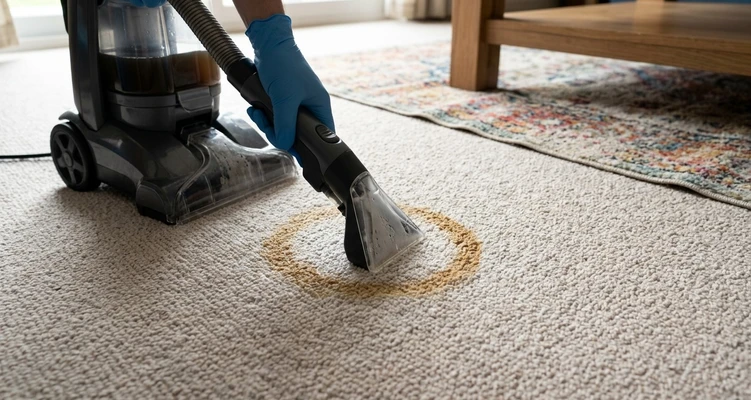
What Is Carpet Wicking?
Carpet wicking is the movement of water-soluble soil or staining material toward the surface of carpet fibers as moisture moves during drying.
The IICRC identifies wicking as a cause of recurring spots and stains and explains that soil left deeper in the carpet can migrate upward as the carpet dries.
This helps explain “why do carpet stains come back?” even when the surface appeared clean immediately after treatment?.
Think about a paper towel absorbing a drop of colored water. The liquid does not necessarily remain in one place. Moisture can travel through the material and carry dissolved substances with it.
Carpet fibers can behave in a somewhat similar way.
A spill may begin at the top of the carpet, but gravity and absorption can allow liquid to move deeper. If the carpet is later saturated during cleaning, the remaining material can become dissolved or suspended in the moisture.
As the carpet dries, some of that material may move back toward the surface. That movement is one of the clearest answers to “Why do carpet stains come back after cleaning?”
What happens during carpet wicking?
The process can be simplified into several stages:
- A liquid spill reaches the carpet.
- Some of the liquid penetrates below the visible fibers.
- Soil or staining material remains deeper in the carpet.
- The carpet becomes wet during cleaning.
- Moisture moves through the fibers while drying.
- Remaining material travels toward the surface.
- The discoloration becomes visible again.
This is one of the clearest explanations for “Why do carpet stains come back after cleaning?”
It also explains why a stain can appear larger after cleaning than it originally looked. The visible area may represent only part of the contamination before moisture redistributes it.
Why Does a Carpet Stain Disappear When Wet and Come Back When Dry?
This is one of the most frustrating parts of recurring carpet stains.
When carpet is wet, its appearance changes. Moisture affects the way light interacts with the fibers, so discoloration can temporarily become less noticeable.
As the carpet dries, remaining soil or staining material becomes visible again.
If a stain starts reappearing during the drying process, wicking should be considered.
This timing can help answer why carpet stains come back in a particular situation.
It is important, however, not to treat timing as absolute proof. Different carpet fibers, spill types, backing materials, cleaning methods, and previous treatments can produce different results.
The better approach is to combine timing with other clues.
Ask yourself:
- Did the stain return while the carpet was drying?
- Does it have the same shape as the original spill?
- Did a ring develop around the original area?
- Was the carpet heavily saturated?
- Had the spill penetrated deeply?
- Were multiple cleaning products used?
If several of these clues match, you have a better starting point for understanding why carpet stains come back rather than simply treating the visible mark again.
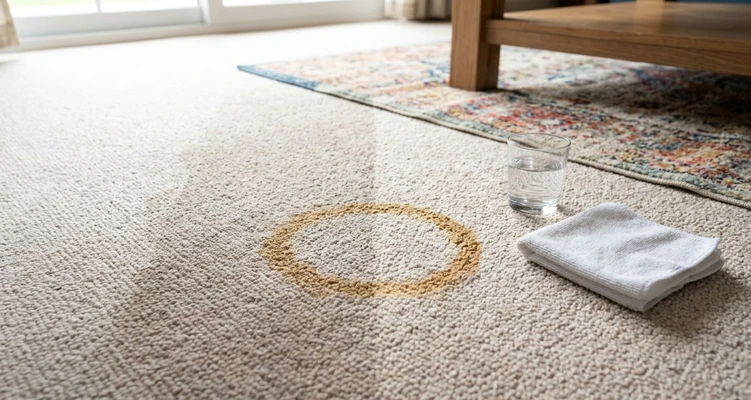
Why Do Carpet Stains Come Back Because of Cleaning Residue?
Not every recurring stain is caused by wicking.
Cleaning residue is another common explanation.
Carpet cleaning products are designed to loosen and suspend soil so it can be removed. However, if excessive product is used or the cleaning process does not remove enough of it, residue can remain in the fibers.
That residue can make the carpet more likely to attract fresh dirt.
This creates a cycle:
Spot appears → cleaner is applied → spot disappears → residue remains → dirt sticks to residue → spot becomes visible again.
This is an important distinction when considering “Why do carpet stains come back?”
The original stain may not have returned at all. Instead, the carpet may simply have collected fresh soil because residue was left behind.
How can you recognize residue-related resoiling?
Look at the timing.
A stain caused by wicking often becomes visible as the carpet dries. A residue problem may take longer to develop because the carpet needs to come back into use before new soil accumulates.
The area may gradually become gray, dull, or dirty rather than returning with exactly the same color as the original spill.
If you are trying to determine “Why do carpet stains come back?” after a DIY treatment, think about what products were used and how much product was applied.
Wicking vs. Residue: How Can You Tell the Difference?
Understanding the difference between these two problems makes it easier to figure out why carpet stains come back in your particular situation.
| What you notice | More likely cause | Why |
|---|---|---|
| The original mark reappears while the carpet dries. | Wicking | The remaining material is moving toward the surface. |
| The same stain returns within a day or two. | Wicking | Moisture can carry deeper contamination upward. |
| A ring appears around the old stain. | Wicking | Moisture and dissolved material can migrate outward. |
| The area gradually becomes gray or dirty | Residue and resoiling | New soil can collect on leftover cleaning product |
| Spot returns after repeated DIY cleaning. | Wicking or residue | Surface treatment may not address the underlying cause. |
| Yellow or brown discoloration develops. | Possible browning | Moisture can contribute to discoloration in some carpets. |
| Carpet color looks permanently lighter. | Possible fiber or dye damage | The problem may be permanent discoloration rather than removable soil. |
The table is not a diagnosis, but it gives you a practical way to start investigating “Why do carpet stains come back?” instead of immediately reaching for another bottle of cleaner.
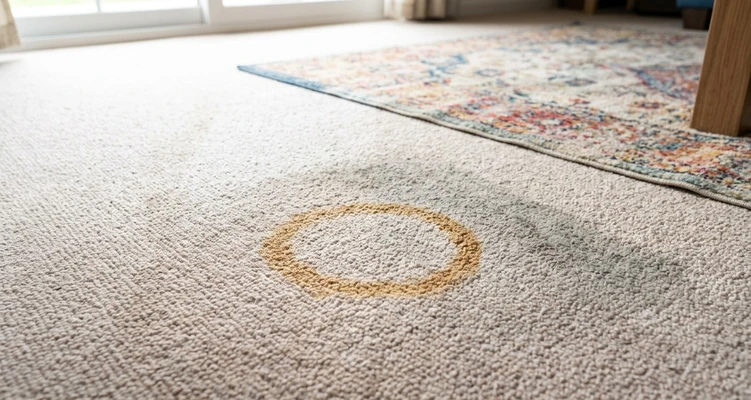
How Deep Can a Carpet Spill Go?
A carpet is more than the fibers you see.
Depending on the carpet construction, there can be the visible pile, primary and secondary backing, adhesive, and carpet cushion underneath. A liquid spill can move beyond the tips of the fibers before you have time to clean it.
This is especially important with larger spills or spills that remain unnoticed for a while.
Coffee, soda, juice, food liquids, and pet accidents can contain substances that remain behind after the obvious moisture has disappeared.
That is why simply making the top of the carpet look clean does not always mean the entire problem has been removed.
The deeper the spill travels, the more important proper extraction and drying become. It is also one reason why carpet stains that come back can be difficult to answer by looking only at the surface.
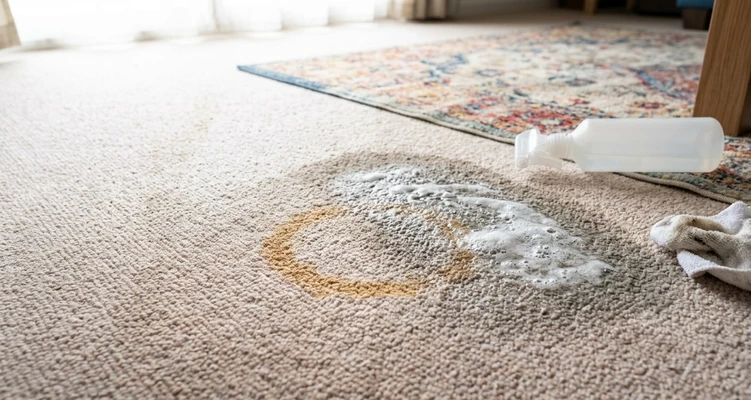
Why Do Carpet Stains Come Back After DIY Cleaning?
DIY carpet cleaning can work well for some minor surface problems, but recurring stains can be more complicated.
One common mistake is assuming that stronger treatment automatically means better treatment.
A homeowner sees the stain return and thinks:
“Maybe I did not use enough cleaner.”
So they apply more.
Then the area gets wetter, more product remains in the fibers, and the carpet takes longer to dry.
If the underlying problem is wicking, the additional moisture may give remaining contamination another opportunity to move. If the problem is residue, additional detergent may make the resoiling problem worse.
This is why understanding “Why do carpet stains come back?” should come before applying another round of cleaning chemicals.
Another common mistake is aggressive scrubbing.
Scrubbing can damage carpet fibers, spread some stains beyond their original area, and push material deeper into the pile. It is generally better to blot a fresh spill rather than aggressively rub it.
Related: Benefits of Professional Carpet Cleaning or DIY Methods
Why Do Carpet Stains Come Back After Professional Cleaning?
Professional cleaning can remove substantial amounts of soil and moisture, but it does not mean every stain will permanently disappear.
That is an important distinction when discussing “Why do carpet stains come back?” after professional service.
Sometimes the original spill has caused permanent color change or fiber damage. In other situations, deeper contamination remains below the surface.
A proper cleaning process should therefore begin with inspection.
The technician needs to consider:
- Carpet fiber type
- Carpet construction
- Age and condition
- Type of spill
- How long the spill remained
- Previous cleaning products
- Existing residue
- Depth of contamination
- Color stability
- Moisture conditions
The treatment should then be selected according to those factors rather than simply applying the same chemical to every stain.
Other Reasons a Carpet Mark Can Come Back
Wicking and residue are important, but they are not the only explanations for “Why do carpet stains come back?”
Browning or yellowing
Some carpet materials contain natural cellulosic components. Excess moisture and slow drying can contribute to brown or yellow discoloration in certain carpets.
This can look like a returning stain even though the mechanism is different from ordinary wicking.
The exact risk depends on carpet construction and materials, so this is one situation where guessing from appearance alone can be misleading.
Permanent color damage
Sometimes a spill changes the carpet color.
Certain chemicals or strongly colored substances can affect dyes or fibers. Cleaning can remove remaining soil without restoring the original color.
If the carpet is genuinely discolored, cleaning more aggressively may not restore it.
That is an important point when asking why carpet stains come back because the visible mark may no longer be a removable stain at all.
Deep pet contamination
Pet accidents deserve special attention because liquid can travel beyond the visible fibers.
If urine reaches the backing or cushion, surface treatment may improve the appearance without completely addressing deeper contamination.
If both a mark and odor keep returning, deeper contamination should be considered rather than repeatedly treating only the visible surface.
For significant pet odor or contamination problems, specialized pet odor removal may be more appropriate than ordinary spot cleaning.
Why Do Carpet Stains Come Back More in High-Traffic Areas?
High-traffic areas experience more soil, friction, moisture, and repeated contact.
If cleaning residue remains in those fibers, everyday foot traffic can quickly introduce new dirt.
This is another reason why carpet stains that come back do not always have a single answer.
A returning dark patch may be a deep coffee spill, but it may also be residue collecting fresh soil.
Sometimes the “returning stain” is actually a difference between a cleaned spot and the surrounding carpet.
If a small area has been cleaned but nearby carpet remains heavily soiled, the cleaned section can initially look very bright. Once the rest of the carpet is viewed under normal lighting and use, the contrast can make the original area appear different again.
What Should You Do When a Carpet Stain Comes Back?
If you are still asking “Why do carpet stains come back?” after cleaning your own carpet, start by observing rather than immediately adding another cleaning product.
Notice when the mark returns.
If it becomes visible while the carpet is drying or within a short period afterward, wicking may be involved.
If it gradually becomes dirty after days or weeks of foot traffic, residue and resoiling may be more likely.
Also look at whether the returning mark has the same shape and color as the original spill.
For a fresh spill, blotting is generally preferable to aggressive scrubbing. Avoid soaking the area repeatedly with different products, especially when you do not know what chemical was already used.
If the same stain repeatedly returns after cleaning, professional inspection can help determine whether the problem is surface soil, residue, wicking, pet contamination, or permanent discoloration.
How Professional Carpet Cleaning Can Help
A professional carpet cleaning process should be more than spraying a chemical over a visible spot.
The first step is identifying what is actually happening. Without that step, it can be difficult to determine “Why do carpet stains come back?” and which treatment is appropriate.
Depending on the situation, professional cleaning may involve thorough dry soil removal, appropriate spot treatment, controlled moisture, hot water extraction, and effective recovery of moisture and dissolved soil.
Steam carpet cleaning, often referred to as hot water extraction, can be useful when the carpet is suitable for that cleaning method.
The important part is not simply putting water into the carpet. The cleaning process must also recover the loosened soil and avoid leaving unnecessary residue behind.
Drying is another important part of the process.
A carpet that remains wet for too long can create additional problems. Good airflow and appropriate moisture control help the carpet return to normal conditions more efficiently.
Related: How Much Does Carpet Cleaning Cost? A 2026 Price Guide
How to Prevent Carpet Stains From Coming Back
You cannot prevent every recurring stain, but you can reduce the risk.
1. Blot spills quickly.
Fresh spills are usually easier to manage before they travel deeper into the carpet.
Use a clean, absorbent material and blot rather than aggressively rubbing the area.
2. Avoid excessive cleaning products.
More product does not automatically mean better cleaning.
Use a product according to its instructions and avoid mixing multiple carpet chemicals.
3. Do not repeatedly soak the same area.
If a spot keeps returning, repeated wet treatments may not solve the actual problem.
The cause needs to be identified. Otherwise, you may keep wondering “Why do carpet stains come back?” without addressing what is happening below the surface.
4. Give the cleaned carpet enough time to dry.
Good airflow can help moisture leave the carpet more efficiently.
Fans and ventilation can be useful, depending on the room and weather conditions.
5. Vacuum regularly.
Routine vacuuming removes dry soil before it becomes embedded in the carpet.
A HEPA vacuum can also be useful for homes where reducing airborne particles and fine dust is a priority.
6. Address spills at the source
If a pet accident, plumbing issue, or repeated food spill is responsible, cleaning the visible mark without addressing the source can lead to the same problem again.
DIY vs. Professional Help for a Returning Stain
| Situation | DIY approach | Professional inspection |
|---|---|---|
| Small fresh surface spill | Often reasonable | Usually unnecessary |
| The stain has been treated once and looks better. | Monitor while drying. | Not always necessary |
| The same stain returns repeatedly. | Limited benefit from repeated treatments | Useful |
| Suspected wicking | Avoid excessive moisture. | Recommended |
| Strong pet odor and recurring marks | Surface cleaning may be insufficient. | Often appropriate |
| Large spill that reached carpet backing | Difficult to assess from the surface. | Recommended |
| Possible permanent discoloration | Home treatment may not restore color. | Useful for diagnosis |
| Unknown previous chemicals | Avoid mixing products. | Safer to have carpet assessed |
The important point is not that every recurring stain requires professional cleaning. It is that repeated treatment without knowing why carpet stains come back can waste time and potentially create a second problem.
Why Do Carpet Stains Come Back in League City Homes?
Homes around League City and nearby Gulf Coast communities can experience changing humidity and indoor drying conditions throughout the year.
That does not mean humidity automatically causes stains to return. However, drying conditions are still worth considering when a carpet remains damp after cleaning.
For homeowners in League City, Dickinson, Friendswood, Pearland, Webster, Pasadena, Seabrook, and surrounding communities, recurring stains should be approached based on the carpet’s actual condition rather than simply applying another bottle of spot cleaner.
A local carpet cleaning professional can inspect the affected area and determine whether the problem appears to be wicking, residue, pet contamination, heavy soil, or something else.
If the issue is primarily a stubborn surface stain, a dedicated carpet stain removal service may be enough. If the carpet has broader soil buildup, a deeper cleaning may make more sense.
Final Thoughts
So, why do carpet stains come back?
Most often, the explanation is not that the carpet somehow created a new stain. The original contamination may still be deeper in the carpet and move toward the surface as moisture leaves the fibers. That process is known as wicking. In other cases, cleaning residue attracts new dirt and creates rapid resoiling.
The key is to look at what happens after the cleaning.
Does the original mark reappear while the carpet dries? Does the area gradually become gray after repeated foot traffic? Is there a yellow or brown discoloration rather than the original spill color? Does an odor return with the mark?
Those clues can point toward very different problems.
If a small spill has just happened, careful blotting and sensible spot treatment may be enough. But if the same mark keeps returning despite repeated cleaning, stop adding more product and look for the reason underneath the surface.
Understanding “why do carpet stains come back” can save you from repeatedly treating the same area without solving the actual problem.
A carpet does not always need more cleaning. Sometimes it needs a better diagnosis.
Frequently Asked Questions
Why do carpet stains come back after they seem completely removed?
The most common explanations are wicking and residue. Wicking can bring remaining staining material from deeper in the carpet back toward the surface as the carpet dries. Residue can attract new dirt and make the same area become dirty again.
How long does it take for a carpet stain to come back?
There is no single time frame. A stain caused by wicking may become visible while the carpet is drying or shortly afterward. Residue-related resoiling may develop more gradually after the carpet is back in use.
Can carpet wicking be fixed?
Often, wicking can be reduced by addressing the remaining contamination and controlling moisture during cleaning and drying. However, the outcome depends on the carpet, original spill, depth of contamination, previous treatments, and whether permanent damage occurred.
Why do carpet stains come back after repeated spot cleaning?
Repeated spot cleaning can leave additional moisture or cleaning residue behind. If the original contamination is deeper than the visible surface, treating only the top fibers may not solve the underlying problem.
Why do pet stains keep coming back?
Pet accidents can penetrate deeper into the carpet than ordinary surface spills. If contamination reaches the backing or cushion, cleaning only the visible fibers may not address everything.
Can professional carpet cleaning prevent a stain from coming back?
Professional cleaning can address soil, residue, and certain types of deep contamination, but no responsible cleaner should guarantee that every stain will disappear permanently. Some stains cause permanent color or fiber damage.
Should I keep putting carpet cleaner on a stain that keeps returning?
Not necessarily. Repeatedly adding cleaning products can increase moisture and residue without addressing the underlying problem. If you keep asking why carpet stains come back, it is better to identify the cause before applying more product.
Related: Carpet Cleaning for Allergies: Can It Really Help You Breathe Easier?
10 Proven High-Traffic Carpet Maintenance Tips
10 Smart Business Carpet Cleaning Frequency Tips to Save Money
Contact Us:
tel: +18326324305